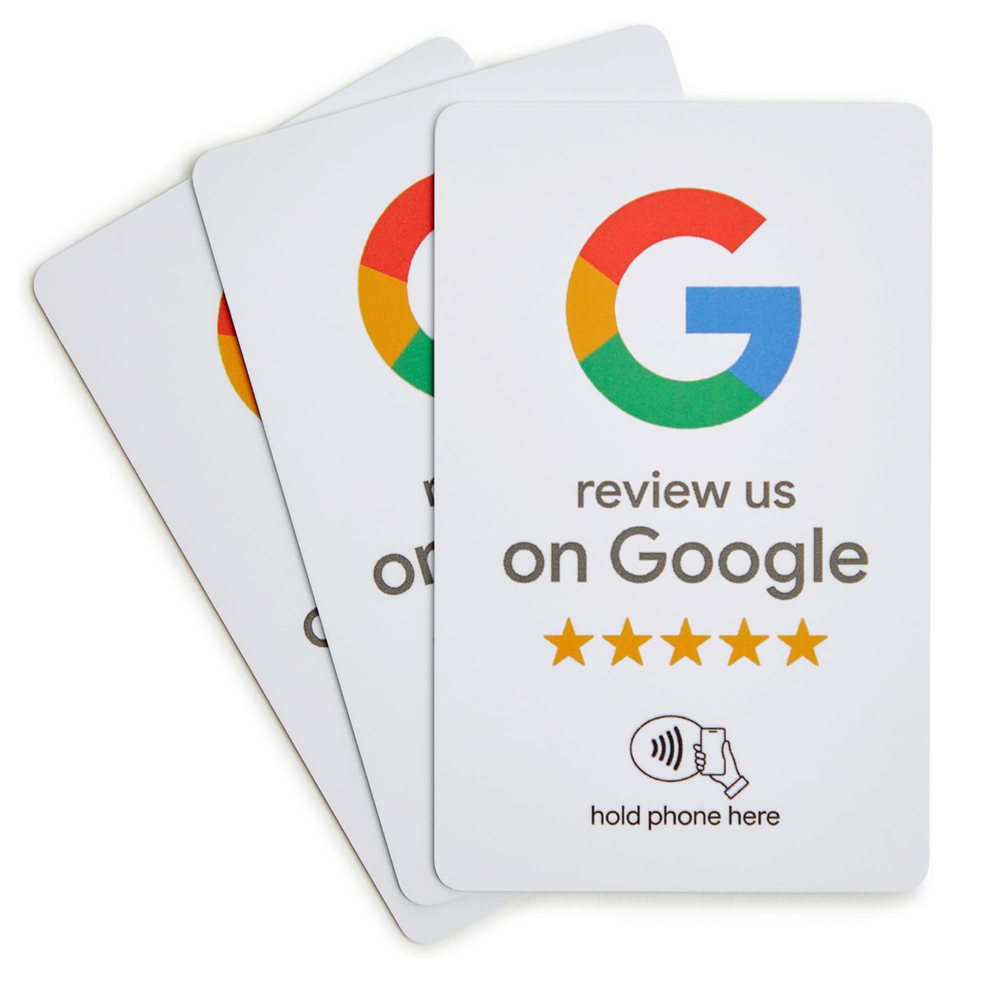
When restaurant owners compare NFC review cards with QR codes for restaurants, the real question is not which tool looks newer. It is which one gets more happy guests to actually leave feedback with the least friction. Speed matters. So does trust. So does whether the prompt fits the dining experience or feels like one more sign people ignore. This guide breaks down the major tradeoffs across guest behavior, operations, cost, and brand perception so you can choose the right restaurant review tools for your floor, counter, or checkout flow.
At a basic level, both tools do the same job. They move a guest from a physical moment in the restaurant to a review page on their phone, often a Google Business Profile review form. But the path is different. A table QR code asks the diner to open their camera, scan, confirm the link, and continue. A Google review card or NFC review card asks the guest to tap a phone on the card and open the prompt. That difference sounds small. In practice, it changes how many people notice the request, how many complete it, and how polished your review ask feels.
What each tool actually does
An NFC review card contains a tiny chip programmed with a web link. When a compatible smartphone comes close, the phone detects the card and shows a prompt that opens a page. In restaurant use, that page is usually your Google review link, though it can also point to a landing page with links to Google, Yelp, TripAdvisor, or an internal feedback form. The guest does not need to type a URL or scan an image. They tap and continue.
Table QR codes work differently. The code is printed on a tent card, table sticker, menu insert, receipt, takeout bag, or wall sign. Guests point their camera at it, wait for the phone to recognize it, then tap the link that appears. That process is familiar because QR menus became common over the last few years. Familiarity is a real advantage. Still, scanning depends on lighting, print quality, camera access, and whether the code is placed where people can comfortably see it.
The phrase Google review card gets used loosely in the market. Sometimes it means a branded NFC card that opens a Google review page. Sometimes it refers to a simple printed card with a QR code linking to Google reviews. For restaurant owners, the important distinction is not the label. It is the interaction model. Tap-based cards and scan-based cards may both drive Google reviews, but they create different guest experiences and different operational demands.
The guest journey and where friction appears
The review request begins before the phone comes out. It starts with timing. A guest finishes a meal, pays, chats with a server, and prepares to leave. At that moment, your tool must do three things fast. It has to get noticed, make sense instantly, and feel safe enough to act on. If any of those steps fail, the guest drops off. That is why comparing review tools only by hardware cost misses the bigger issue.
With table QR codes, the first friction point is visual clutter. Many tables already hold menus, payment prompts, seasonal ads, Wi-Fi signs, and tabletop promos. A review QR can blend into the background. Guests often stop seeing signs once they sit down. Even when they notice the code, they may assume it links to a menu, loyalty sign-up, or survey, not specifically to a review page. If the call to action is weak, the code becomes furniture.
NFC review cards create a different moment. They are usually handed to the guest with the check, placed at the host stand, or presented near checkout. That makes them more active than passive. The staff member can say, “If you enjoyed your visit, you can tap here to leave us a quick Google review.” The action is clearer, and the physical handoff increases attention. But there is a catch. Some guests do not know where to tap, or whether their phone supports NFC. If the instruction is vague, the card can create hesitation instead of momentum.
Drop-off patterns are different too. QR codes lose people at the noticing and scanning stages. NFC tends to lose people at the understanding stage, mostly among guests unfamiliar with tap interactions outside of payments. That means the “better” tool depends less on the technology itself and more on your diners, your service style, and how clearly you present the prompt.
Speed, ease of use, and guest trust
In pure motion terms, NFC is usually faster. A tap can open the review page in one smooth action. No camera. No aiming. No waiting for the code to focus. In a busy quick-service setting or a coffee shop line, that matters. Guests are often standing, holding a drink, managing a wallet, or watching kids. Reducing one or two steps can make the difference between intent and completion. Small friction kills response rates. Restaurants feel this more than most businesses because the review ask often happens in transition, not in a calm office setting.
That said, QR codes are easier to understand at a glance because the behavior is already learned. Most diners know what to do with a QR image. An NFC card can feel magical to younger users and mildly confusing to others. Older guests, tourists with different phone habits, and less tech-comfortable diners may need a verbal cue. A short printed line helps a lot. “Tap your phone here to leave a Google review” is better than “Review us.” Clear beats clever.
Phone compatibility also shapes ease of use. Most modern smartphones support NFC, but behavior varies by device and settings. On newer iPhones and many Android phones, NFC works with little effort. On some devices, users may need to unlock the screen or position the phone more carefully. QR codes, by contrast, work on nearly every smartphone with a camera, though they fail more often when the code is damaged, small, glossy, or poorly lit. If you operate in dim bars or patio spaces at night, QR performance can drop fast. NFC is less affected by lighting.
Trust is another dividing line. Guests have become cautious about unknown links. Generic QR stickers can feel suspicious, especially if they look homemade or have been placed over old materials. People have seen stories about fraudulent QR swaps in parking lots and public spaces. A branded NFC review card with your logo, clean design, and a direct mention of Google often feels more legitimate. It looks intentional. It looks like part of the hospitality experience rather than an afterthought. Still, trust can swing the other way if the card appears too salesy or if staff pressure guests to use it at the table.
Brand fit and operational practicality
A review tool is not just a conversion device. It is also part of the room. In casual restaurants, visual clutter is easier to tolerate. In fine dining, boutique hospitality, and chef-driven concepts, clutter is expensive because it changes the feel of the experience. Table QR codes can hurt aesthetics if they are oversized, laminated, or placed next to premium tableware. Even a high-performing code can be the wrong fit if it cheapens the space.
NFC review cards usually win on presentation. They can be designed like mini brand assets with consistent colors, logo, and messaging. They can live in the check presenter, at the host desk, near the pastry case, or beside the register. Because they do not have to stay visible all meal long, they reduce table clutter. This is especially useful in higher-end restaurants that want the review ask to happen after service, not during it.
Operationally, QR codes are simpler and cheaper to deploy at scale. Print, place, and replace as needed. For multi-unit restaurants, this matters. A chain can standardize code artwork, send it to local printers, and install it across dozens of locations in days. NFC review cards require ordering hardware, programming links, and tracking physical pieces. Cards can disappear, get damaged, or walk off. If staff use them actively, training becomes more important. Someone has to know when and how to present the card without sounding robotic.
Maintenance looks different for each tool. QR assets fade, peel, stain, or crack. Once that happens, scan rates drop. Restaurants often forget to audit them until results sag. NFC cards usually hold up better physically, but they are easier to misplace. A host stand card might survive for months. A handheld card used by servers may vanish by Saturday. Neither option is maintenance-free. The better question is which type of maintenance fits your team. If your operation is disciplined about tabletop materials, QR can be easy. If your team already uses check presenters and host interactions well, NFC fits naturally.
Which method performs best by restaurant type
Full-service restaurants often get the strongest results from NFC review cards used at the payment or departure moment. The reason is emotional timing. A good meal ends with a human interaction. If the server or host prompts gently after a positive experience, the request feels personal. The guest does not have to remember the table sign from 40 minutes earlier. They act when satisfaction is fresh. That tends to improve completion.
Fast casual and coffee shops can go either way. If customers order at a counter and move quickly, a countertop NFC stand near pickup can work very well because the action is immediate. Tap while waiting for a receipt, then leave a short rating. But QR codes also work in these environments because people are already used to scanning posted offers and loyalty prompts. Cost and traffic volume often push these operators toward QR first, then NFC in high-performing locations.
Bars present a unique case. Low light hurts QR scanning. Sticky surfaces ruin stickers fast. Guests may also be less patient with multi-step interactions late at night. NFC can be more reliable here, especially near checkout or on a bar-top stand. Still, loud environments reduce the odds that staff can explain how to use the card. The design needs to do the teaching on its own.
Food trucks and takeout-heavy businesses often benefit from QR codes on packaging because the review can happen later. That is a powerful use case. A diner may not stop outside the truck to leave a review, but they might scan a takeout bag at home. NFC is less useful once the guest leaves unless the card is fixed to a returnable piece, which is uncommon. Hotels with restaurant outlets sometimes use a hybrid model. QR on receipts and rooms for passive collection, NFC at host stands or breakfast exits for active collection.
Fine dining usually favors NFC because subtlety matters. A small branded card in the check presenter feels controlled and intentional. A large table QR may interrupt the tone of the room. The review ask should feel like a continuation of service, not a marketing insert.
Review volume, review quality, and Google impact
Most restaurants care about one metric first. More Google reviews. That makes sense because Google reviews influence local pack visibility, click-through rates, and diner trust before anyone visits your website. Both restaurant review tools can point to the same Google review link, so the platform destination is not the differentiator. The difference is how many happy guests reach that destination and complete the action.
Lower friction usually increases volume. In many settings, NFC can produce a higher completion rate because tap is fast and attention is concentrated in a single moment. However, higher volume does not automatically mean higher quality. The easiest paths often produce shorter reviews, quick star ratings, and fewer detailed comments. That is not necessarily bad. A steady flow of recent ratings can strengthen local search performance and social proof. Detailed reviews are valuable, but consistency often matters more than essay length.
QR codes can sometimes generate more delayed reviews, especially from takeout and delivery customers who scan later from packaging or receipts. Those reviews may include more detail because the guest is not in a rush to leave the restaurant. The tradeoff is lower total conversion. People intend to review later and forget. Restaurants overestimate this later behavior all the time. “They’ll do it at home” usually means they won’t.
Accuracy on Google matters more than many operators realize. Whether you use NFC or QR, the link must open the correct Google Business Profile review page for that exact location. Multi-location brands often make this mistake. A table sign in the downtown unit links to the corporate homepage, a store locator, or the wrong branch. Every extra step lowers completion, and every listing mismatch wastes goodwill. Test links on iPhone and Android. Test them on guest Wi-Fi and mobile data. Then test them again after any profile updates.
There is also a compliance and ethics angle. The tool should invite honest feedback, not screen for only positive reviews before sending users to Google. Restaurants can ask happy guests for reviews and invite dissatisfied guests to speak with a manager, but deceptive gating practices create risk and can damage trust. The cleaner approach is simple. Ask for feedback graciously, make the process easy, and fix service issues offline when they happen.
Cost, ROI, and the decision framework
Printed QR codes are almost always cheaper upfront. You can create them in minutes, print them on existing materials, and deploy them across tables, receipts, packaging, and windows with minimal investment. For new restaurants, independent operators on a tight budget, and chains testing a review program for the first time, this low barrier is attractive. If your current review generation process is basically nothing, a decent QR rollout may already produce a strong lift.
NFC review cards cost more because there is hardware involved. Unit cost is not huge, but it adds up when you want multiple placements, branded production, backups, and replacements. There is also staff time. If the card is part of the service script, training matters. But ROI should not be judged only on purchase price. If NFC increases review completion at the exact moment your happiest guests are ready to act, the payback can be fast. A few dozen additional Google reviews can influence local ranking, map clicks, reservation interest, and first-time traffic in a way that far exceeds the cost of a handful of cards.
A practical way to decide is to score each option on five variables. Service model. Guest demographics. Brand presentation. Staff involvement. Placement flexibility. If your operation relies on counter service, visible signage, and low-cost deployment, QR codes for restaurants often win. If your experience is hospitality-led, visually curated, and capable of a brief verbal prompt, NFC review cards often outperform. If your guests skew older or less tech-confident, do not assume NFC is harder. With a simple instruction and staff cue, many guests find tapping easier than scanning. But if your room is highly self-service and staff interaction is limited, QR may be more dependable.
For many restaurants, the smartest answer is hybrid. Use QR where passive visibility makes sense, on receipts, takeout bags, table tents, or counter signs. Use NFC where active timing makes sense, in check presenters, at the host stand, or near checkout. This covers both immediate and delayed behavior without forcing one tool into every moment. The key is not to duplicate the ask everywhere until the restaurant looks like an ad board. Pick one primary moment and one backup moment.
Implementation determines outcomes more than the technology itself. Keep the message short. Name the destination. “Tap to leave a Google review” or “Scan to review us on Google” works better than vague language. Make the design clean and on-brand. Test the exact path from phone to posted review. Train staff to ask only after a positive interaction and never in a pushy way. Review requests should feel like an invitation, not an obligation. When restaurants miss with these tools, it is usually because the request is mistimed, the link is wrong, the sign is ugly, or nobody checked whether the experience actually works in the real dining room.
The bottom line is simple. If you want the best blend of speed, polish, and in-the-moment conversion, NFC review cards usually have the edge. If you want the lowest-cost, broadest, easiest-to-deploy option, QR codes for restaurants remain highly effective. The best choice depends on your guest flow and your brand standards. Choose the tool that removes the most friction for your specific environment, then execute it cleanly. That is what turns a review prompt into real local reputation growth.