
An RFID tag is a small electronic label that can be identified wirelessly.
It communicates with an RFID reader through radio waves, which means it does not need the same direct visual alignment that a barcode does.
For companies working on warehouse efficiency, retail accuracy, or asset visibility, RFID is not just another label. It is a way to make physical items part of a live data system.
So, what exactly is an RFID tag?
RFID stands for Radio Frequency Identification.
An RFID tag is the part of the RFID system attached to an item, carton, pallet, garment, device, file, or product package. It stores identifying information so the system can recognize and track that item during movement, storage, or use.
A typical RFID tag includes:
- A microchip that stores data
- An antenna that sends and receives signals
Some tags also include specialized materials or protective layers so they can perform reliably on metal, plastic, glass, or in demanding environments.
A simple way to think about it is this:
A barcode must be seen to be scanned. An RFID tag only needs to be within range to be read.
How does an RFID tag work?
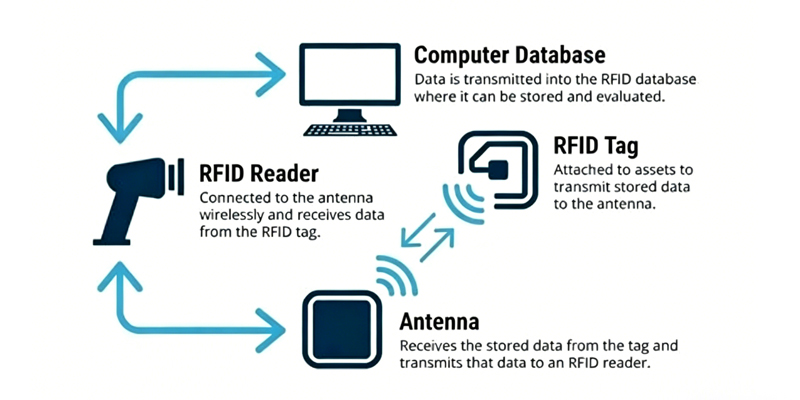
The basic process is straightforward.
An RFID reader sends out a radio signal. When an RFID tag enters that signal field, the tag responds by transmitting its stored information back to the reader. The reader then passes that data to software, where it can support inventory counts, shipment verification, asset tracking, or process visibility.
A complete RFID setup usually includes:
- RFID tags attached to items
- RFID readers that capture tag data
- Antennas that support read coverage and signal performance
- Software systems that manage and display the data
In my experience, most companies do not struggle with understanding the concept of RFID. They struggle with a more practical question: will it actually work in their environment?
That depends on tag selection, read points, materials, workflow design, and system integration. The technology matters, but the fit matters more.
The three main types of RFID tags
Not all RFID tags work the same way. Choosing the right type has a direct impact on performance, budget, and long-term results.
1. Passive RFID tags
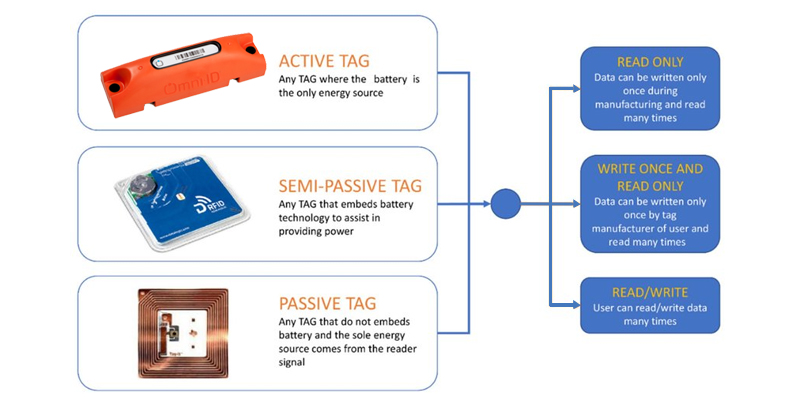
Passive RFID tags do not contain a battery. They draw power from the signal sent by the RFID reader.
That makes them more affordable, easier to scale, and well suited for high-volume applications. For many warehouse, retail, and supply chain projects, passive tags are the starting point.
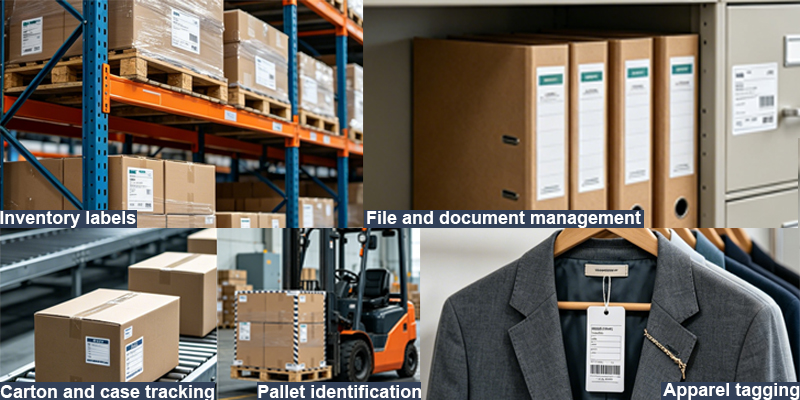
Common uses include:
- Inventory labels
- Carton and case tracking
- Pallet identification
- Apparel tagging
- File and document management
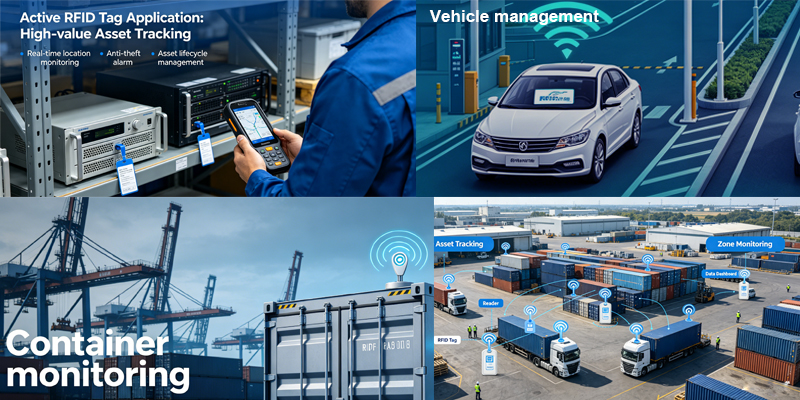
2. Active RFID tags
Active RFID tags contain their own battery, which allows them to transmit over longer distances.
They usually cost more and take up more space, but they are valuable in environments where range and continuous visibility matter.
Common uses include:
- High-value asset tracking
- Vehicle management
- Container monitoring
- Large site or yard visibility
3. Semi-passive RFID tags
Semi-passive tags also include a battery, but they use it differently from active tags. They often support more stable performance or sensing functions in specialized applications.
Common uses include:
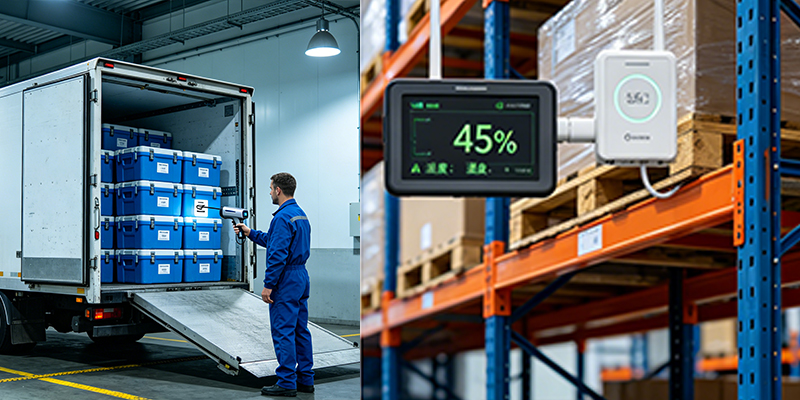
- Cold chain monitoring
- Industrial environments
- Temperature or condition tracking
Why are more businesses using RFID tags?
The answer is not “because the technology is new.” It is because operational pressure keeps increasing.
Teams deal with the same problems every day:
- Inventory records do not match physical stock
- Cycle counts take too long
- Inbound and outbound processes depend too heavily on labor
- Multi-item handling creates scanning bottlenecks
- Peak periods increase missed scans and data errors
- Shared assets disappear into daily operations
This is where RFID starts to prove its value.
Faster inventory counting
Barcode-based counting often requires workers to scan each item individually. RFID can read multiple items quickly without requiring a direct view of every label.
For warehouses, stockrooms, and high-turnover environments, that speed advantage becomes obvious almost immediately.
Fewer manual errors
The more steps a process relies on human action, the more variation and mistakes it creates. RFID automates identification and improves consistency.
For operations leaders, reliability matters more than novelty. A solution that reduces friction and stabilizes execution will always outperform one that only looks advanced on paper.
Better visibility across movement
Each RFID tag can carry a unique identifier. That allows businesses to know what an item is, where it has been, and when it moved through a specific checkpoint.
That kind of traceability supports smarter replenishment, clearer audits, and stronger control over operations.
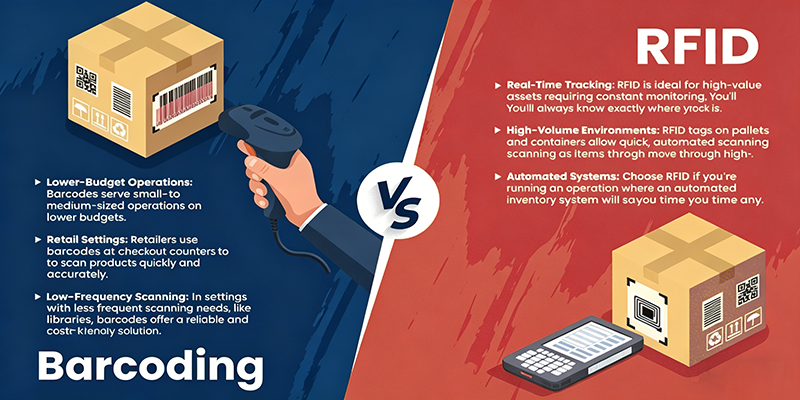
RFID tags vs barcodes: what is the real difference?
This is one of the most common questions during early evaluation.
The better question is not whether RFID should replace barcodes everywhere. The better question is whether your workflow needs more speed, automation, and visibility than barcode systems can realistically provide.
Where barcodes still make sense
- Low cost
- Easy to implement
- Familiar across teams
- Good for simple, item-by-item identification
Where RFID has the advantage
- No line of sight required
- Multiple tags can be read at once
- Faster data capture
- Better fit for automation
- Stronger support for tracking and process control
If your environment is low-volume and simple, barcodes may remain the right choice. But when you manage high SKU counts, fast-moving inventory, or repeated bulk handling, RFID often creates a much stronger operational return.
Professional advice: do not frame RFID as a universal replacement. Frame it as the right tool for more demanding workflows.
Three situations where RFID tags make the biggest difference
Warehouse and logistics operations
Warehouses are often the easiest place to see RFID value in action.
When cartons, pallets, or reusable containers carry RFID tags, businesses can capture data during receiving, put-away, movement, picking, and shipping with far less manual intervention. Read points at dock doors, conveyor zones, or process checkpoints create a more automated flow.
What teams usually notice first:
- Faster receiving and shipping
- Shorter inventory counts
- Fewer missed scans
- More accurate stock visibility
Retail stores and stockrooms
Retail inventory problems are rarely caused by a lack of systems. They usually come from the gap between real store activity and what the system thinks has happened.
Fitting rooms, returns, replenishment, transfers, and busy sales periods all create inventory distortion. RFID-tagged merchandise helps stores count faster, locate products more easily, and maintain a more accurate view of available stock.
That affects two things immediately:
- Whether shoppers can actually find the size or color they want
- Whether staff spend time serving customers or fighting inventory problems
Asset management
Laptops, tools, medical devices, testing equipment, and shared operational assets become difficult to control as quantity increases.
RFID tags help businesses assign identity to each asset and create a cleaner process for check-out, return, counting, and location tracking. For many teams, the biggest benefit is simple peace of mind. They stop guessing where things are.
What should you consider before choosing an RFID tag?
This is where many projects go off track.
A tag may look cost-effective on paper, but if it does not perform reliably on the actual item or in the real environment, the project becomes expensive very quickly.
Here are the questions that matter most:
- What surface will the tag be applied to: cardboard, plastic, metal, or glass?
- How far away does it need to be read?
- Are there size limitations?
- Will it be used indoors, outdoors, in heat, or in moisture?
- Is it disposable or reusable?
- Does it need to work with existing systems and infrastructure?
In my experience, stable read performance matters more than unit price.
A tag that saves a few cents but causes read failures, rework, or inconsistent results will cost far more over the life of the project. A reliable, repeatable deployment always wins.
Why your team will thank you
RFID tags do not solve every operational problem. They do solve one of the most common ones: the gap between physical movement and usable data.
That matters because once a business grows, manual tracking starts to break under pressure. Teams waste time confirming what should already be visible. Managers make decisions using partial information. Processes slow down because every checkpoint needs human attention.
RFID changes that. It allows items to identify themselves within the workflow.
That means less repetitive scanning. Less uncertainty. Fewer delays during high-volume periods. And a much clearer picture of what is really happening on the floor.
The takeaway
An RFID tag is not just a piece of hardware. It is a practical tool that helps businesses turn physical activity into reliable data.
As operations grow more complex, that shift becomes more valuable. Warehouses need faster throughput. Retail teams need more accurate stock. Asset-heavy organizations need stronger control. RFID helps connect those needs to a more efficient process.
If you are evaluating an RFID project, start with one honest question:
What kind of friction is your team dealing with every day that should no longer be manual?
That is usually where the case for RFID becomes clear.
Want to explore which RFID tag fits your warehouse, retail, or asset-tracking workflow? Join the conversation with teams building more reliable operations through smarter labeling and identification.